
How Essential Oils Can Complement Acupuncture Practice

Updated: Jul 2
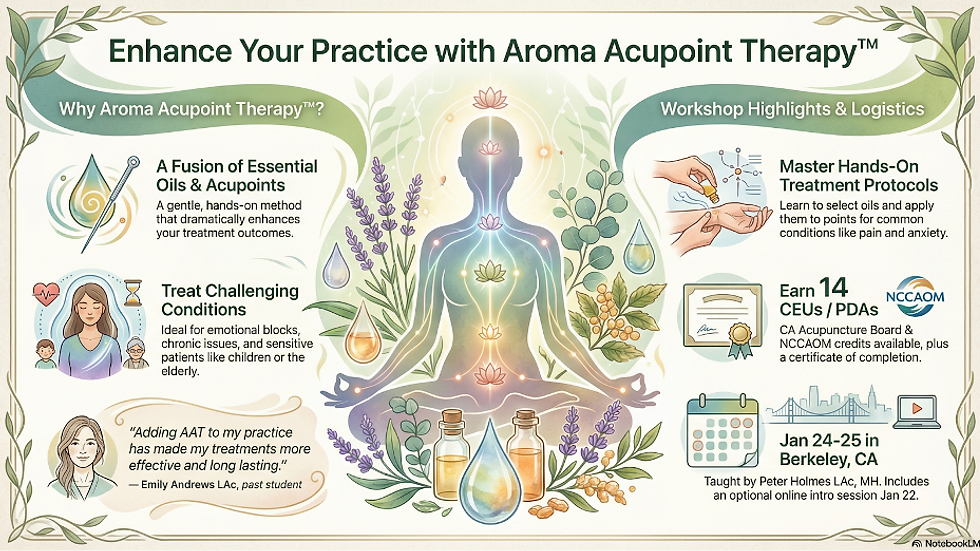
In clinical practice, acupuncturists and bodywork practitioners often encounter situations where progress slows or patients struggle with standard treatment approaches. Chronic conditions may plateau, emotional patterns may resist change, or certain populations—such as children, elders, or those with needle sensitivity—may require gentler forms of care.
These challenges invite us to explore complementary methods that work within the framework of Chinese medicine while expanding our treatment options. One such approach is Aroma Acupoint Therapy™ (AAT), a hands-on modality that integrates essential oils with the channel system.
What Is Aroma Acupoint Therapy™?
Aroma Acupoint Therapy™ is a structured clinical method that pairs specific essential oils with designated acupoints to support energetic and physiological regulation. Rather than focusing solely on scent, AAT is informed by Chinese medicine theory and diagnostic principles.
This approach differs from general aromatherapy in that it is taught as a complete system, with clear frameworks for assessment, oil selection, and point application. The goal is to enhance treatment effectiveness while providing a non-invasive and accessible experience for patients.
“Adding AAT to my practice has made my treatments more effective and longer lasting. I’ve seen progress in cases that had previously plateaued.” — Emily Andrews, LAc
Supporting Treatment with a Gentle Approach
AAT emphasizes subtle intervention. Essential oils are applied to selected acupoints and held gently, allowing us to work with energetic patterns without strong stimulation. Clinically, we may observe shifts in pulse quality, facial expression, emotional state, or symptom presentation during or shortly after treatment.
Because the method does not rely on forceful techniques, it can also support practitioner sustainability by reducing physical strain during treatment sessions.
“I appreciate how AAT allows me to continue effective treatment even when my patients are particularly sensitive. It has added another dimension to my practice without adding physical strain.” — Sarah Lin, LAc
An Option for Sensitive Patient Populations

One of the strengths of Aroma Acupoint Therapy™ is its suitability for patients who may not tolerate needling or stronger manual techniques. It can be a useful option for:
Infants and children
Elderly patients
Individuals who are needle-averse or highly sensitive
Patients with chronic illness or low vitality
Clients experiencing psycho-emotional patterns
For these populations, AAT may help support relaxation, nervous system regulation, and symptom relief while remaining gentle and accessible.
“I’ve used AAT with children and older adults who could not tolerate acupuncture alone. It provides a safe and effective option that these patients respond well to.” — Michael Chen, LAc
A Structured System Rooted in Chinese Medicine Theory

Although essential oils are widely used in wellness settings, Aroma Acupoint Therapy™ is taught as a clinically grounded system rather than an intuitive approach. Training includes:
The Six-Condition Assessment, a diagnostic framework used to guide treatment decisions
Principles of Fragrance Energetics, describing the energetic qualities and directional actions of essential oils
Protocols for selecting and pairing oils with specific acupoints
These tools are designed to help us integrate essential oils thoughtfully into existing acupuncture or bodywork practices.
“The clarity and organization of the Aroma Acupoint training is exceptional. The material is highly relevant and can be applied immediately in practice.” — Ellen Ellis, LAc
Hands-On Training for Clinical Application
Training in Aroma Acupoint Therapy™ emphasizes both theoretical understanding and hands-on experience. Participants practice administering and receiving treatments, which supports practical skill development and clinical confidence. This approach allows us to apply what we learn directly in our own practices.

Upcoming Workshop at AIMC Berkeley
Aroma Acupoint Therapy™ will be offered as an in-person intensive at AIMC Berkeley, presented by the Peter Holmes & Snow Lotus Institute.
Workshop Details
Instructor: Peter Holmes, LAc, MH (with live Mandarin interpretation by Gloria Yuan, MIFA)
請注意:為了讓以中文為母語的夥伴有更好的學習體驗,本次研討會全程將對所討論的要點提供現場中文即席翻譯。我們很高興邀請到我們在亞洲的AAT主要講師Gloria Yuan前來跨刀相助。
Dates: January 24–25, 9:00 AM–5:00 PM
Location: AIMC Berkeley, 2550 Shattuck Ave., Berkeley, CA 94704
Pre-Class Online Session: January 22, 7:00–9:00 PM PST (Included with tuition; introduces Fragrance Energetics and Six-Condition Diagnosis)
Continuing Education: 14 California Acupuncture Board CEUs and 14 NCCAOM PDAs pending

Reference Materials: The workshop draws on Peter Holmes’ extensive body of work, including Aromatica, Clinical Aromatherapy, The Energetics of Western Herbs, Jade Remedies, and The TCM Materia Medica Clinical Reference & Study Guide.
This workshop is open to licensed acupuncturists, students, and practitioners interested in integrative approaches within Chinese medicine. Participants will have the opportunity to engage with clinical frameworks and protocols directly derived from Peter Holmes’ research and publications on essential oils, herbal energetics, and clinical applications.
For registration and additional details, visit snowlotuseducation.com or contact info@snowlotus.org.
About Peter Holmes

Peter Holmes is a practitioner of Oriental Medicine and Medical Herbalist with over 30 years’ experience using botanical remedies and essential oils in clinical practice. He continues to develop both physiological and psychological applications for essential oils and has pioneered their use in Chinese and energetic medicine for more than three decades.
Peter is co-creator, along with Tiffany Pollard, of Aroma Acupoint Therapy™, and is the author of several acclaimed textbooks on herbal and essential oil medicine, including:
Aromatica
Clinical Aromatherapy
The Energetics of Western Herbs
Jade Remedies
The TCM Materia Medica Clinical Reference & Study Guide
His work bridges traditional Chinese medicine theory, Western herbal knowledge, and essential oil applications, emphasizing safe, precise, and clinically effective treatments.
Closing Reflections
Aroma Acupoint Therapy™ offers a structured, gentle way to integrate essential oils into acupuncture practice while remaining grounded in Chinese medicine theory. Continued study and hands-on training, such as the upcoming intensive at AIMC Berkeley, support thoughtful clinical integration and ongoing professional development.
As with any modality, we are encouraged to evaluate how and when such tools may be appropriate within our own clinical contexts.
Exploring Further
As we delve deeper into the world of integrative medicine, it’s essential to remain open to new methodologies. Aroma Acupoint Therapy™ is just one of many innovative approaches that can enhance our practice. By embracing these techniques, we can better serve our patients and foster a more holistic approach to healthcare.
Let us continue to learn and grow together in our journey toward making holistic care more accessible.


Comments