
Critical Tasks in the Occupational Analysis: Building an Acupuncture Curriculum to Scale

CALE Occupational Analysis: 153 Critical Tasks · 13 Subareas
The occupational analysis identifies the critical tasks an entry-level acupuncturist performs, following the procedure of care from first contact to a safe, documented close. What follows is that practice drawn to scale — every stage, subarea, and task weighted by its criticality and placed in procedural sequence, offered here as an instructional guide for curriculum development.
FOUR STAGES OF PRACTICE TO SCALE
The Clinical Procedure
Every critical task belongs to one of four stages of care, in the order they occur in practice. Each stage's weight is its share of entry-level practice — and treatment carries nearly half.
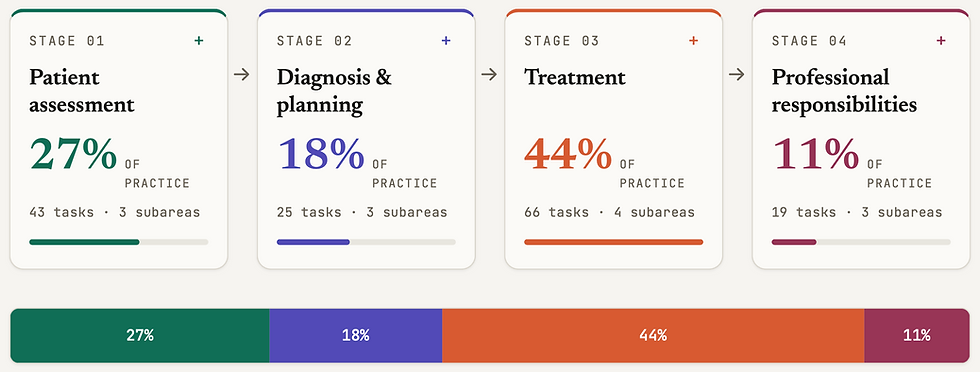
In curriculum terms, weight is the signal for instructional emphasis: contact hours, clinical exposure, and assessment should be distributed in roughly these proportions.
PRACTICE TO SCALE
One Hundred Percent, Every Block Proportional
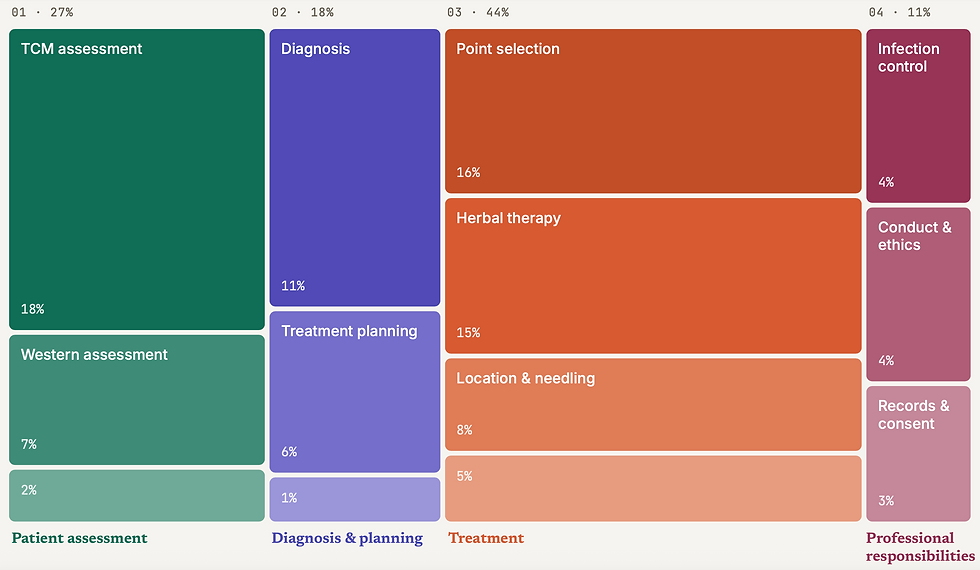
Column width represents each stage's share of entry-level practice; each block's height represents its subarea's share within that stage. Read left to right as the procedure of care unfolds — the whole grid represents the profession's critical work, and each block is a competency cluster whose size suggests its curricular footprint.
INSIDE SUBAREAS
Every Critical Task, Placed in Sequence
Each subarea is sized to its share of practice, and inside it, tasks run in procedural order. Each task is a candidate entry-level competency statement, drawn directly from the task inventory (5 retired IDs omitted from the original 158).
Stage 01 — Patient assessment** · 43 tasks · 27% of practice
- *0101 TCM assessment (18%)* — Tasks 1, 3–34
- *0102 Western assessment (7%)* — Tasks 57–63
- *0103 Referrals & emergency (2%)* — Tasks 55–56
Stage 02 — Diagnosis & planning** · 25 tasks · 18% of practice
- *0201 Diagnosis (11%)* — Tasks 35–47
- *0202 Treatment planning (6%)* — Tasks 48–53
- *0203 Communication (1%)* — Tasks 54, 64–68
Stage 03 — Treatment** · 66 tasks · 44% of practice
- *0301 Point selection (16%)* — Tasks 69–98
- *0302 Location & needling (8%)* — Tasks 99–108
- *0303 Adjunct modalities (5%)* — Tasks 109–122
- *0304 Herbal therapy (15%)* — Tasks 123–139
Stage 04 — Professional responsibilities** · 19 tasks · 11% of practice
- *0401 Records & consent (3%)* — Tasks 140–146
- *0402 Infection control (4%)* — Tasks 147–151
- *0403 Conduct & ethics (4%)* — Tasks 152–158
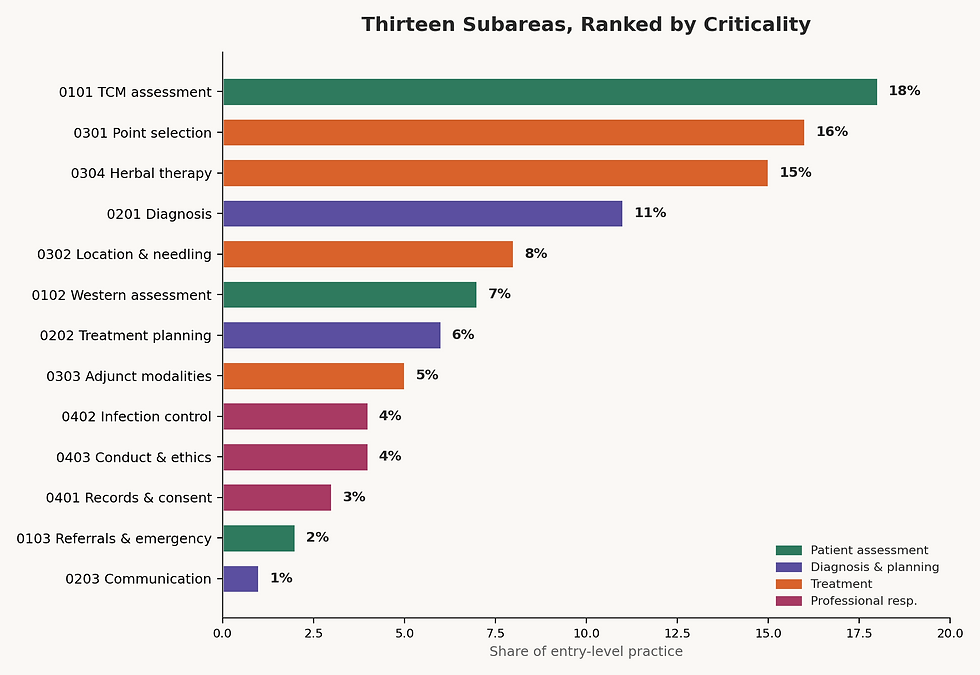
Subareas Ranked
FROM ANALYSIS TO CURRICULUM
Establishing Competencies for Entry into the Profession
Because the analysis describes what practitioners actually do at entry level, it is the
empirical basis for the curriculum: each critical task becomes a competency to be
taught, practiced and assessed before graduation.
Weighting → Emphasis | Sequence → Scaffolding | Tasks → Competencies |
Allocate instructional time proportionally | Order instruction along the procedure of care | Translate tasks into entry-level competencies |
Distribute didactic hours, clinical exposure, and assessment weight in proportion to each subarea's share of practice — treatment (44%) and assessment (27%) anchor the clinical curriculum, not the margins of it. | The procedural sequence is the natural scaffold for coursework and clinical training: assessment before diagnosis, diagnosis before treatment planning, treatment before independent professional responsibility. | Each T-numbered task is already stated as an observable behavior. Map every course outcome and clinical evaluation item to the tasks it develops, so graduation requirements demonstrably cover the profession's critical work. |
*CALE Occupational Analysis · 2021
Comments